So far in the Fretello Summer Guitar Camp, you've learned how to read chord diagrams, play your first chord progression, and keep a steady rhythm. That's already a fantastic achievement!
Now it's time to add something that makes your guitar playing feel more natural and expressive: strumming patterns. A slow, steady strum can sound calm and reflective, while a lively pattern can make the very same chords feel energetic and upbeat.
The best part? You don't need to learn dozens of patterns right away. Mastering one simple pattern will already open the door to hundreds of songs.
Let's get started!
What Is a Strumming Pattern?
A strumming pattern is simply the sequence of downstrokes (↓) and upstrokes (↑) you use while playing chords.
Think of it as the rhythm of your right hand.
Instead of randomly moving your hand across the strings, a strumming pattern creates a consistent groove that listeners can follow.
Once you've learned a few basic patterns, you'll notice them appearing again and again in rock, pop, country, folk, and countless other styles.
Downstrokes and Upstrokes
Before learning your first pattern, let's understand the two basic movements.
Downstroke (↓)
A downstroke means moving your pick—or your fingers—from the thickest string toward the thinnest string.
This is usually the strongest, most natural movement and is where every beginner should start.
Upstroke (↑)
An upstroke is the opposite.
You move from the thinnest strings back toward the thickest.
At first, this movement may feel less comfortable, but with practice it becomes just as natural.
The secret is to keep your hand relaxed. Avoid gripping the pick too tightly or forcing the movement. Let your wrist do most of the work while your forearm stays relaxed.
Your First Strumming Pattern
Today's pattern is one of the most common beginner rhythms:
↓ ↓ ↑ ↑ ↓ ↑
Don't worry if it looks complicated at first. Let's break it down.
Count:
1 & 2 & 3 & 4 &
Now match the strums to the count:
1 ↓
2 ↓
& ↑
3 ↑
4 ↓
& ↑
It may take a few tries before it feels natural—and that's perfectly okay.
Start slowly and focus on keeping a steady beat rather than getting every movement perfect.
Keep Your Hand Moving
Here's a tip that experienced guitarists use without even thinking about it:
Keep your strumming hand moving continuously.
Even when you're not hitting the strings, your hand should continue moving up and down with the beat.
This helps you maintain a consistent rhythm and makes more advanced patterns much easier to learn later.
Imagine your hand swinging like a pendulum—it never suddenly stops.
Practice with Your Chord Progression
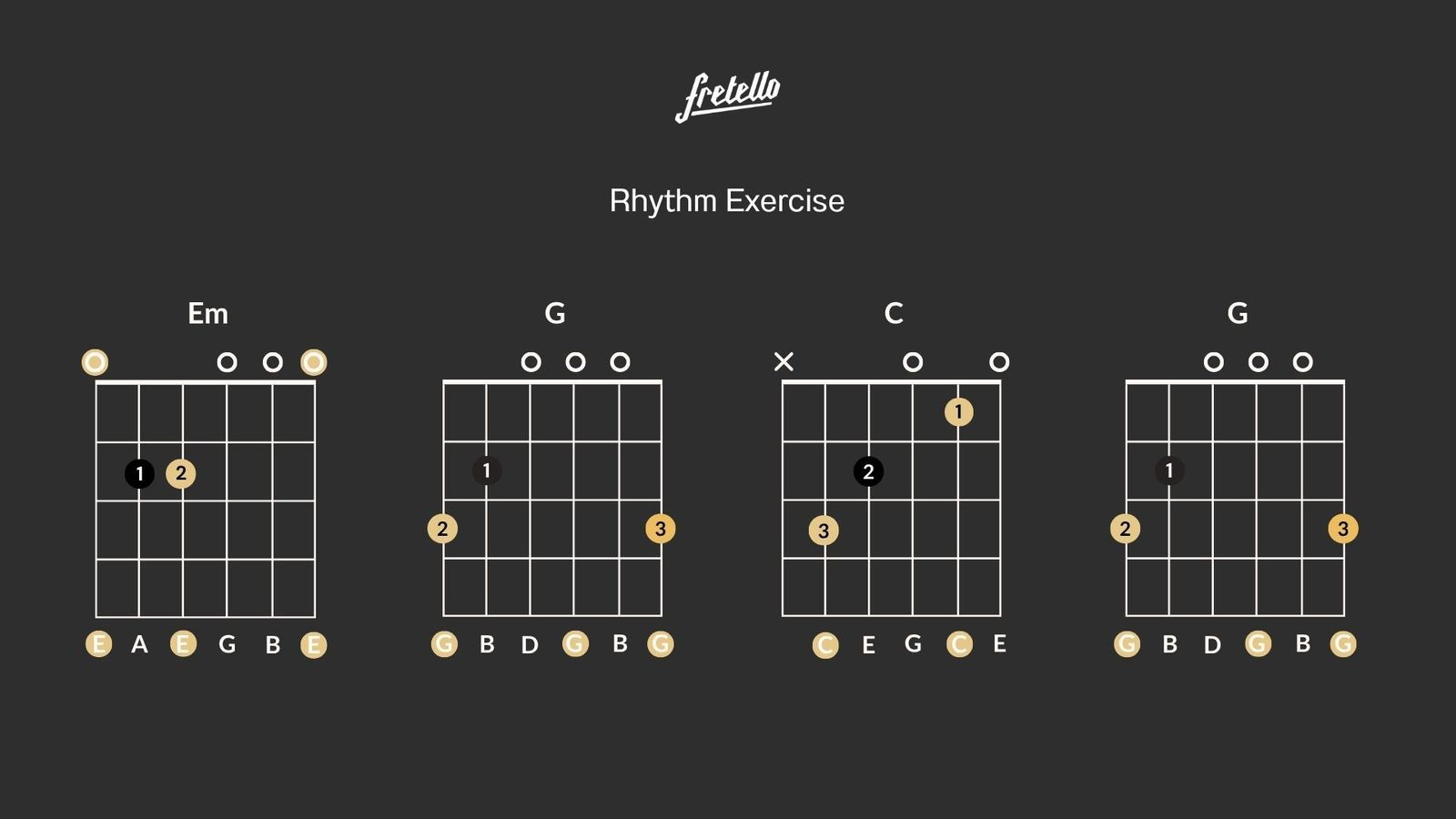
Let's use the progression you've already learned:
Em → G → C → G
Play each chord for one full strumming pattern before changing to the next.
At first, don't worry if you miss a string or accidentally play an extra one.
Your goal is simply to stay relaxed and keep the rhythm flowing.
After a few repetitions, you'll notice your playing sounding smoother and more musical.
Common Beginner Mistakes
Every guitarist experiences a few bumps when learning to strum. Here are the most common ones—and how to avoid them.
Playing Too Fast
The pattern will come naturally with time. Start slowly enough that every movement feels comfortable.
Stiff Wrist
A tense wrist makes strumming harder than it needs to be.
Relax your grip and let your wrist move freely.
Stopping Between Chords
Many beginners freeze their strumming hand while changing chords.
Instead, try to keep your hand moving continuously, even if the chord change isn't perfect yet.
Chasing Perfection
You don't need every strum to sound flawless.
Good rhythm is more important than perfect accuracy.
Practice Challenge
Today, set aside 10–15 minutes for focused practice.
- Play the strumming pattern without changing chords.
- Tap your foot while counting 1 & 2 & 3 & 4 &.
- Add the Em → G → C → G progression.
- Repeat the progression five times.
If it feels difficult, slow it down.
Every smooth repetition builds confidence.
How Fretello Can Help
Learning a new strumming pattern is much easier when you can practice step by step.
With Fretello, you'll find structured beginner lessons that introduce new techniques gradually, interactive exercises that help you stay on beat, and guided practice sessions designed to improve both your rhythm and chord changes. As you progress, you'll unlock even more songs and exercises that put your new skills into action.
Start your 7-day free trial today and discover how enjoyable learning guitar can be with a practice plan that grows alongside your skills.
What's Next?
Congratulations—you've just learned one of the most widely used strumming patterns in modern guitar playing.
It may feel a little awkward today, but every time you practice, your movements will become smoother and more natural.
In our next Summer Guitar Camp lesson, we'll explore one of the biggest challenges for beginners: switching between chords quickly and confidently. With a few simple techniques, you'll spend less time looking at your fingers and more time enjoying the music.
Keep strumming, stay patient, and most importantly—have fun!